You see headlines all the time. "The average household income is $75,000." "The average home price in the city is $500,000." Sounds straightforward, right? But here's the thing—those "average" numbers, more technically called the mean, can be complete liars. They get pulled around by a handful of super-high or super-low numbers, painting a picture that doesn't match reality for most people. That's where understanding what a median is becomes your secret weapon. It's the middle point in a dataset, and it cuts through the noise of outliers to show you what's typical. If you've ever looked at a statistic and thought, "That doesn't feel right," you were probably sensing the difference between the mean and the median.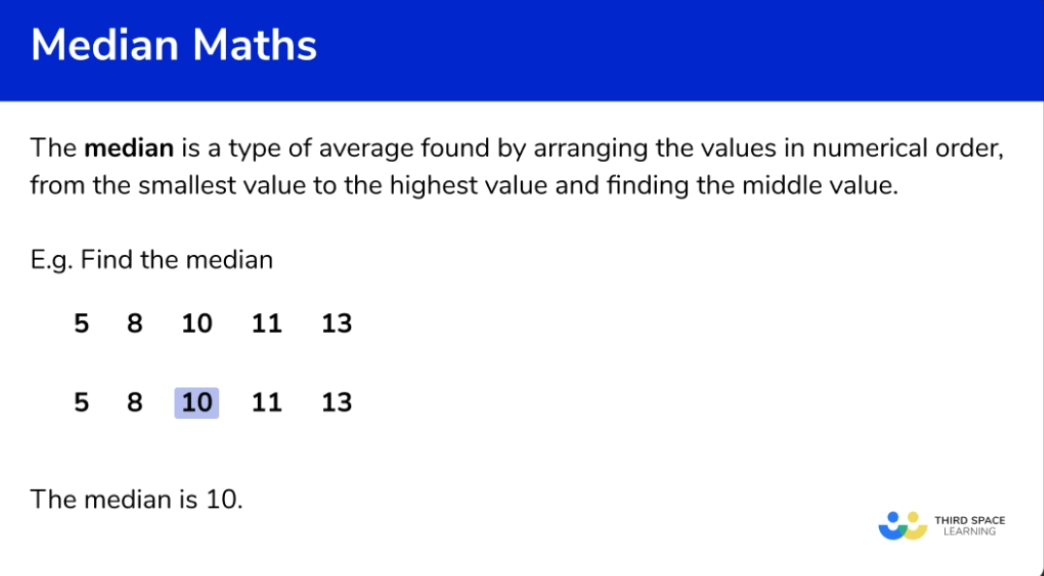
What You'll Find Inside
- What Exactly Is a Median? A Simple Definition
- Why the Median Often Matters More Than the Mean
- How to Calculate the Median: A Step-by-Step Walkthrough
- Where You'll See the Median Used in the Real World
- Mean vs. Median: The Key Differences in Plain English
- A Real-World Case Study: Income in a Small Town
- Your Questions About Medians, Answered
What Exactly Is a Median? A Simple Definition
Let's strip away the jargon. The median is the middle number. Imagine you line up all your numbers from smallest to largest. The one right in the center of that line is the median. Half the numbers are bigger than it, and half are smaller.
That's the core idea. It doesn't care how big the biggest number is or how tiny the smallest one is. It just finds the center. This makes it incredibly resistant to being skewed. If ten people in a room make $50,000 a year and one billionaire walks in, the average (mean) income skyrockets to millions. But the median income? It stays right around $50,000, which is a much more accurate reflection of what a typical person in that room earns.
The Quick Mental Model
Think of it like finding the middle person in a line by height. You don't add up everyone's height and divide. You just sort them and pick the one in the middle. That person's height is the "median height" of the group. Simple.
Why the Median Often Matters More Than the Mean
This isn't just a math trivia point. Choosing the wrong measure can lead to terrible decisions.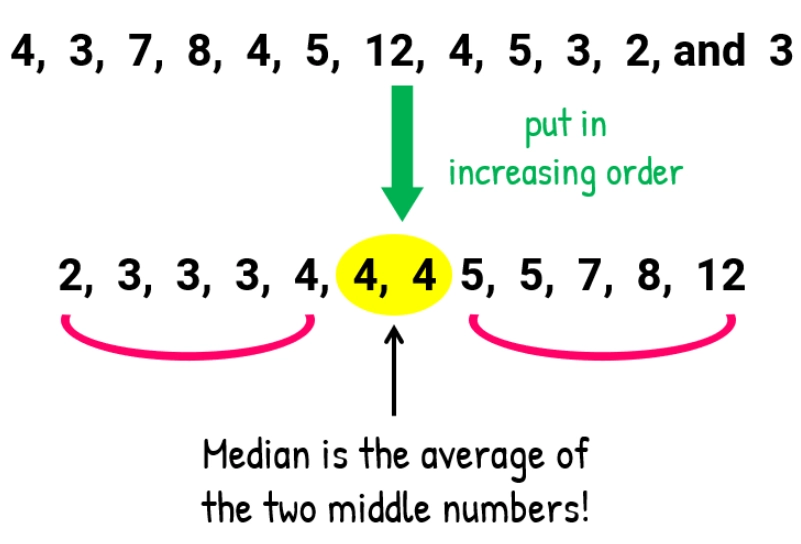
I remember looking at a report for a potential investment in a neighborhood. The brochure proudly stated the "average household net worth" was exceptionally high. It looked great on paper. But when I dug into the local property records and census data, I found the median household net worth was less than a third of that average. Why? A few massive, multi-million dollar estates on the outskirts were dragging the average up, while most families in the actual neighborhood were doing okay, but not spectacularly well. Relying on the mean would have completely misled me about the local economy and spending power.
The median gives you the typical experience. The mean gives you the mathematical center of gravity, which can be heavily influenced by extremes. For understanding what life is like for most people, which house most people can afford, or what salary most workers actually take home, the median is almost always the more honest and useful number.
How to Calculate the Median: A Step-by-Step Walkthrough
You don't need fancy software. You can do this by hand. Let's walk through it with two examples: one with an odd number of data points, and one with an even number—this is where many guides gloss over a subtle but important detail.
Case 1: Odd Number of Values
Let's say we have home prices on a street: $250k, $300k, $320k, $400k, $2.1 million.
- Sort them: They're already sorted from lowest to highest.
- Find the middle position: With 5 numbers, the middle is the 3rd number. A quick trick: (5 + 1) / 2 = 3.
- Identify the median: The 3rd number is $320,000.
See how that $2.1 million mansion didn't affect the median at all? The typical home on this street is $320k, not the average which would be over $670k.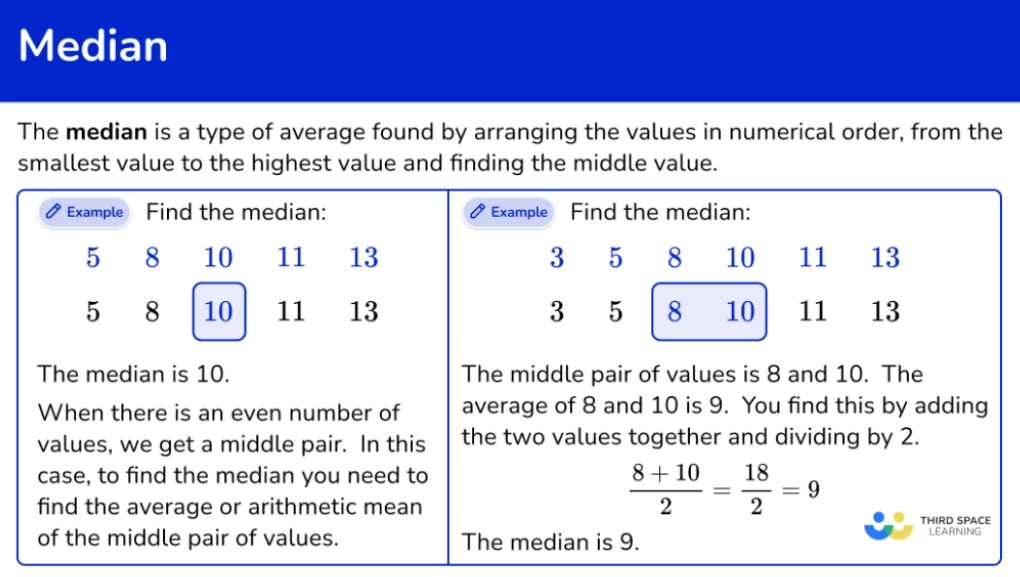
Case 2: Even Number of Values
Now, let's look at monthly rent for six apartments: $900, $950, $1,100, $1,200, $1,300, $1,500.
- Sort them: Done.
- Find the two middle positions: With 6 numbers, the middles are the 3rd and 4th numbers. Formula: positions 6/2 and (6/2)+1, which are 3 and 4.
- Calculate the average of those two middle values: ($1,100 + $1,200) / 2 = $1,150.
The common mistake here is to just pick one of the two numbers. You must take their average. This is the formal, correct definition for an even set.
Here's a table to visualize the process for different dataset sizes:
| Dataset | Sorted Values | Number of Items | Middle Position(s) | Median Calculation | Median Value |
|---|---|---|---|---|---|
| Home Prices | 250k, 300k, 320k, 400k, 2100k | 5 (odd) | 3rd | Value at position 3 | $320,000 |
| Apartment Rents | 900, 950, 1100, 1200, 1300, 1500 | 6 (even) | 3rd & 4th | (1100 + 1200) / 2 | $1,150 |
| Test Scores | 72, 78, 85, 88, 92, 95, 99 | 7 (odd) | 4th | Value at position 4 | 88 |
Where You'll See the Median Used in the Real World
Once you know to look for it, you'll see the median everywhere in reputable reporting and analysis.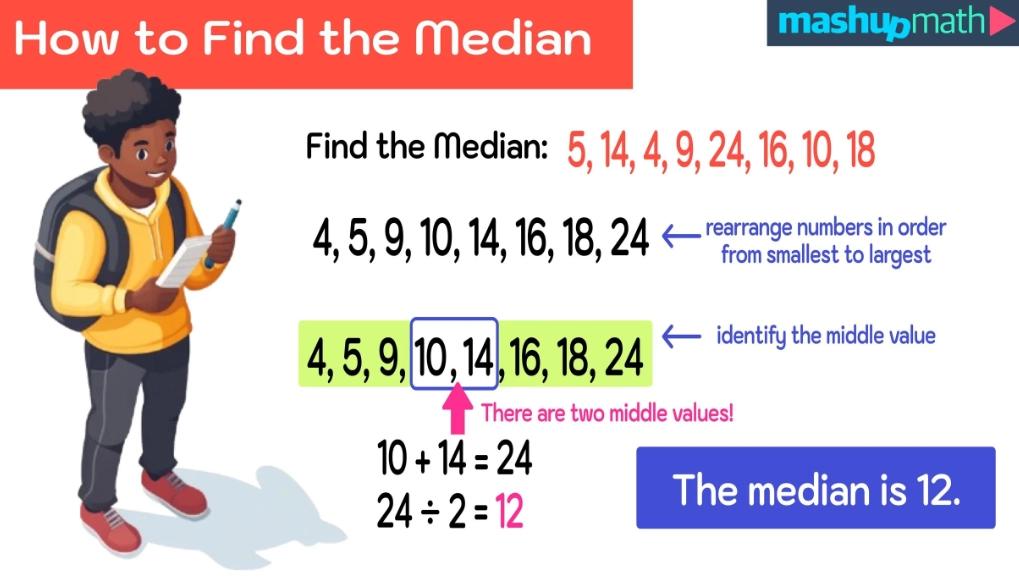
- Income and Wealth Reports: The U.S. Census Bureau and most government statistics agencies lead with median household income, not average. For 2022, the U.S. median household income was about $74,580. This tells you more about the standard of living for a middle-class family than an average skewed by top earners.
- Real Estate: Realtor associations and sites like Zillow report median home sale prices for cities and neighborhoods. This is crucial because a few ultra-luxury sales can make an area look unaffordable on average, while the median shows the price of a typical transaction.
- Investment Analysis: When looking at the returns of a set of mutual funds or the performance of stocks in a sector, the median return can be more informative than the average, especially if a few funds had spectacular crashes or gains.
- Demographics and Surveys: Median age, median commute time, median years of education. All these are used because they represent the experience of the person in the middle of the pack.
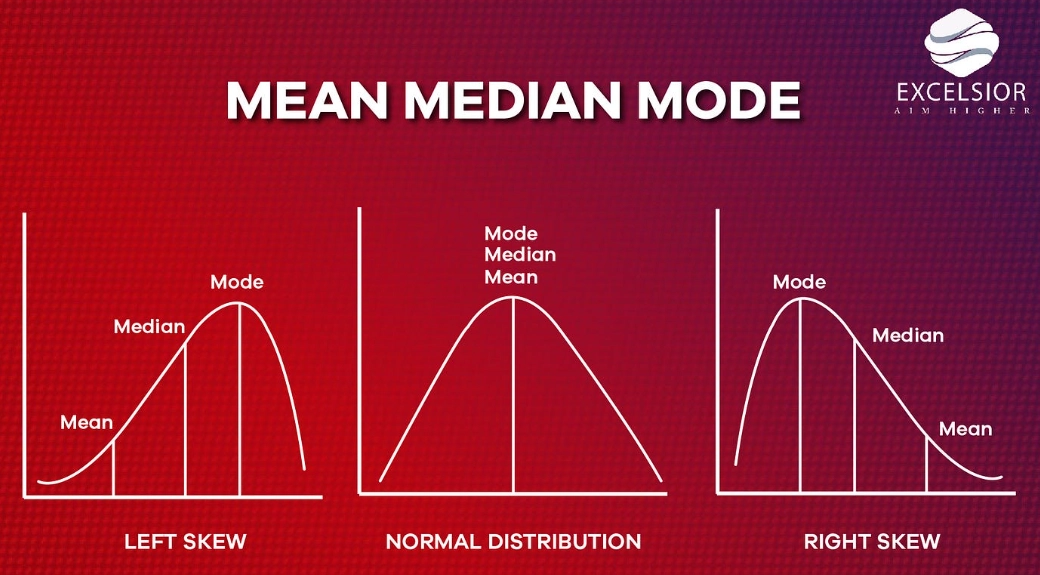
If a report only shows you an average, be skeptical. Ask for the median. The difference between the two numbers itself tells a story—a large gap indicates a skewed distribution with outliers.
Mean vs. Median: The Key Differences in Plain English
Let's settle this once and for all.
The Mean (Average) is calculated by adding all numbers and dividing by the count. It uses every single data point. This is its strength and its weakness. It's great for data that is symmetrically distributed (like heights of adult men) where there are no extreme outliers. It's also essential in algebra and higher math.
The Median is found by sorting and picking the middle. It ignores the actual values of the extremes, only caring about their position. This is its superpower for real-world, messy data that is often skewed (like incomes, home prices, or hospital bill sizes).
Here's the simplest rule of thumb: Use the median when you want to know what's "typical" or "common." Use the mean when you need to include all values in a total, like calculating the total cost or combined weight.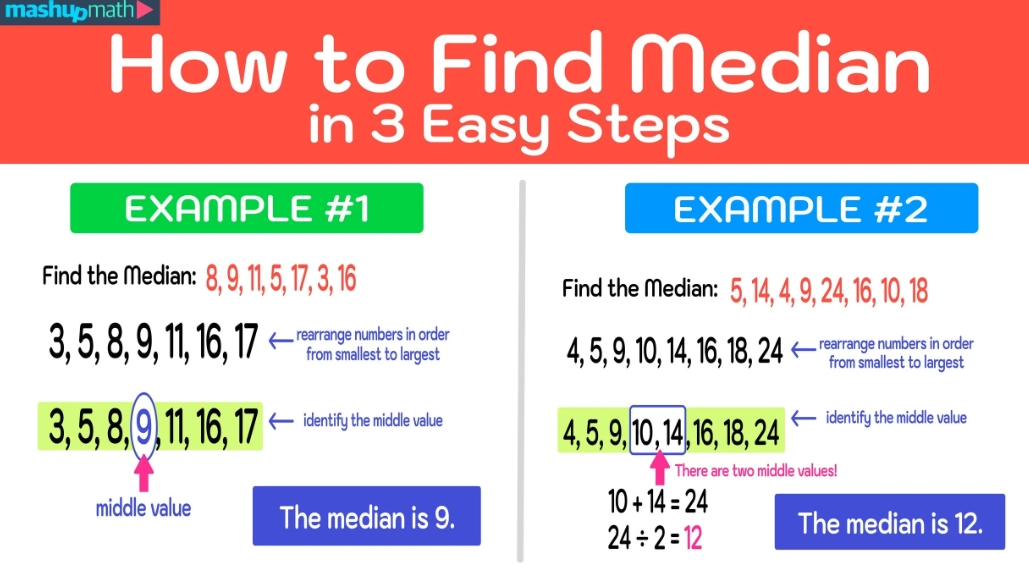
A Real-World Case Study: Income in a Small Town
Let's make this concrete. Imagine "Maple Creek," a town with 11 residents. Here are their annual incomes:
$32,000, $35,000, $38,000, $40,000, $42,000, $45,000, $48,000, $52,000, $55,000, $60,000, $1,200,000.
That last one is the town's only tech entrepreneur who sold her startup.
- Calculate the Mean (Average): Add them up: $32k + $35k + ... + $1.2 million = $1,647,000. Divide by 11. Mean Income ≈ $149,727.
- Calculate the Median: Sort (already done). With 11 numbers, the middle is the 6th number. Median Income = $45,000.
Now, which number better represents the economic reality for a random person living in Maple Creek? If a new business used the mean ($149,727) to set prices, it would fail. The median ($45,000) tells the truth: most people are making a modest living. The town's tax base or total income might be influenced by the millionaire (that's where the mean is useful), but the day-to-day economy runs on the median.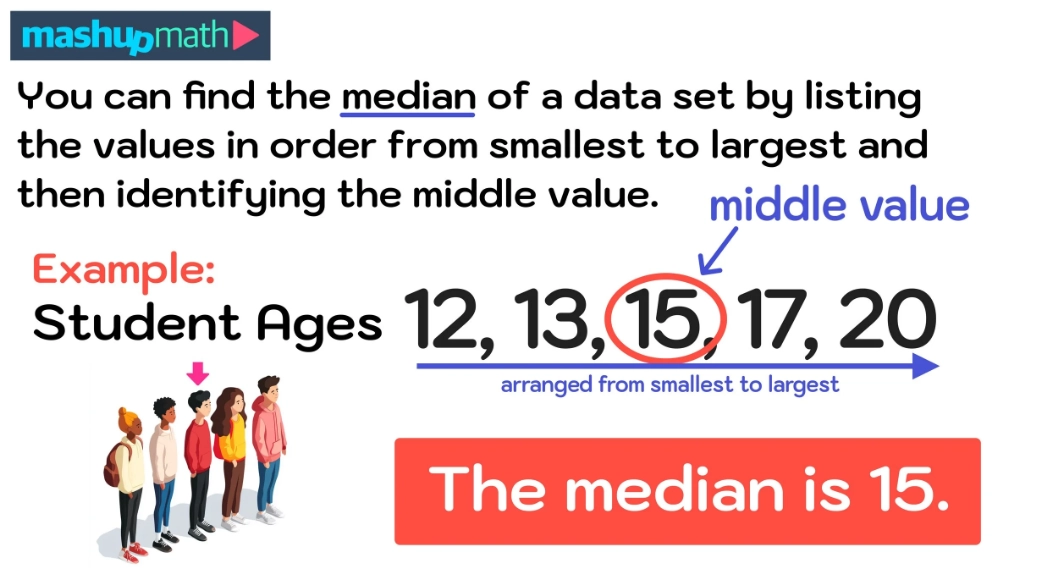
Your Questions About Medians, Answered
Why does my company's HR report show an "average salary" that seems much higher than what most of my colleagues make?
They're almost certainly reporting the mean. Executive and senior leadership salaries are often orders of magnitude higher than entry-level or mid-level salaries. These high outliers pull the average up dramatically. If they reported the median salary, you'd see a number much closer to what the typical employee in the middle of the pay band actually earns. It's not necessarily deceptive on purpose (means are easier to calculate from payroll totals), but it's less informative for most employees.
When analyzing my investment portfolio's annual returns, should I look at the median or average return?
Look at both, but give more weight to the median if you have a diversified portfolio. Let's say you have 10 stocks. Nine returned between 5% and 10%, but one speculative bet lost 70%. The average return might be low or even negative, scaring you. The median return, however, would show a solid 7-8%, reflecting the performance of your typical holding. The median tells you your strategy's core performance, while the mean shows the total impact, including the bad bet.
 I see "median" used for house prices. Does that mean half the houses sold for less, or that half the houses *are worth* less?
This is a crucial distinction. The reported median sale price refers to the price of the house that was literally in the middle of all houses that sold in a given period. It does not reflect the value of every house in the area, including those not for sale. So, it means half of the transactions were below that price. It's the best gauge of the current market for buyers and sellers, but it's a snapshot of activity, not a census of all property values.
Is the median always a better measure than the mean?
No, not always. The median has a weakness: it throws away a lot of data. If you're a school teacher and you want to know the total number of books read by your class to order certificates, you need the sum, which comes from the mean. If you're an engineer ensuring a bridge can hold weight, you need to account for extreme stress cases, not just the typical case. Use the median for understanding the central tendency of skewed data (most social and economic data). Use the mean for symmetrical data or when the total matters.
Grasping what a median is moves you from passively consuming numbers to actively interrogating them. It turns you from someone who might be misled by a flashy average into someone who demands the more truthful, typical story hidden in the middle of the data. The next time you see a statistic about money, prices, or performance, pause. Ask yourself: "Is this the mean or the median?" That single question will make you a savvier consumer, investor, and citizen.
Reader Comments