Let's cut to the chase. If you're comparing two investments, and one returned 12% last year while the other returned 8%, which is better? Most people would instinctively say the 12% fund. That's the wrong way to look at it, and it's a mistake that costs investors real money. The real question is: what did you have to endure to get that return? That's where the Sharpe ratio comes in. It's the single most important metric for judging whether your returns are worth the gut-wrenching volatility you suffered along the way. Think of it as your portfolio's "bang-for-your-buck" score.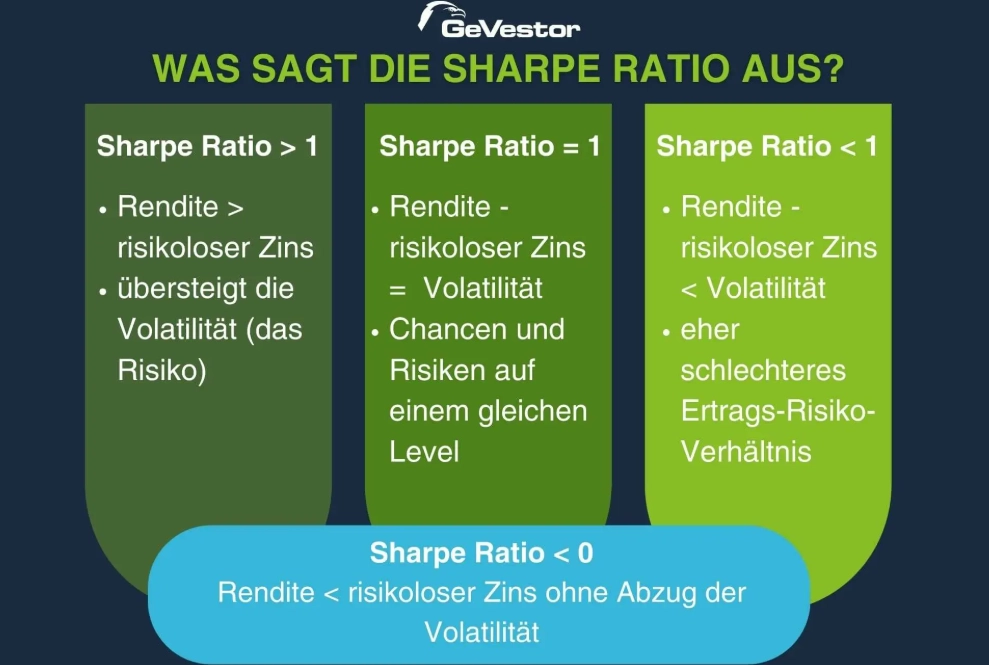
What You'll Learn
- What Is the Sharpe Ratio? (Beyond the Textbook Definition)
- How to Calculate the Sharpe Ratio: A Step-by-Step Walkthrough
- Interpreting Your Sharpe Ratio: What Do the Numbers Mean?
- The Critical Limitations of the Sharpe Ratio (What Most Guides Don't Tell You)
- How to Use the Sharpe Ratio in Your Actual Investment Process
- Sharpe Ratio FAQ: Your Burning Questions Answered
What Is the Sharpe Ratio? (Beyond the Textbook Definition)
Officially, the Sharpe ratio is a measure of risk-adjusted return. It was developed by Nobel laureate William F. Sharpe. The formula compares your investment's excess return (the return above a "risk-free" rate like a Treasury bill) to its volatility (standard deviation).
But here's the intuitive, non-textbook version. Imagine two delivery drivers.
Driver A averages 20 deliveries a day, but his route is chaotic. Some days he makes 30 deliveries, other days he breaks down and makes only 10. The stress is high, and his van is constantly in the shop.
Driver B averages 18 deliveries a day. His route is smooth and predictable. He consistently hits between 17 and 19 deliveries every single day. Low stress, reliable van.
Who's the better driver? Driver B, obviously. He's almost as productive with far less drama and cost. The Sharpe ratio formalizes this logic for your investments. It penalizes the "Driver A" portfolio—the one with flashy headline returns but wild, unpredictable swings.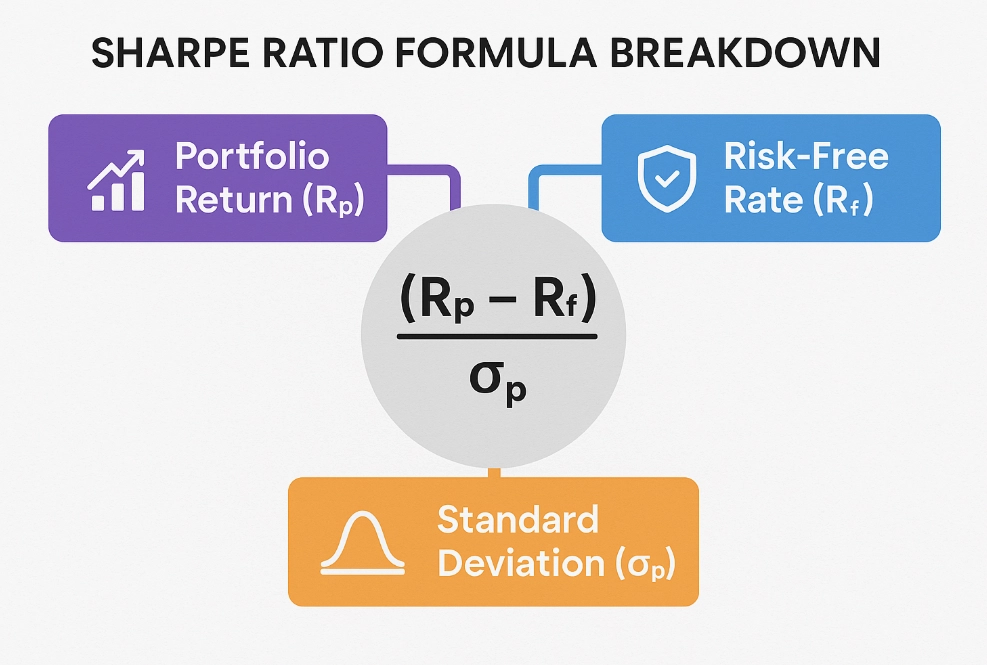
How to Calculate the Sharpe Ratio: A Step-by-Step Walkthrough
The textbook formula is: Sharpe Ratio = (Rp - Rf) / σp
- Rp = Average return of the portfolio/investment.
- Rf = Risk-free rate (e.g., the yield on a 3-month U.S. Treasury bill).
- σp = Standard deviation of the portfolio's excess returns (i.e., its volatility).
Let's move beyond symbols and run a real, hypothetical example. We'll compare two funds over a three-year period.
A Practical Case Study: The "Growth Tech Fund" vs. The "Steady Balanced Fund"
Assume the risk-free rate (Rf) averaged 2% per year over this period.
Growth Tech Fund (GTF):
Year 1 Return: +25%
Year 2 Return: -5%
Year 3 Return: +30%
Average Annual Return (Rp): (25 - 5 + 30) / 3 = 16.67%
Excess Returns: (25-2)=23%, (-5-2)=-7%, (30-2)=28%
Standard Deviation of Excess Returns (σp): ~18.0% (calculated using a standard deviation formula).
Steady Balanced Fund (SBF):
Year 1 Return: +9%
Year 2 Return: +7%
Year 3 Return: +11%
Average Annual Return (Rp): (9+7+11) / 3 = 9.0%
Excess Returns: (9-2)=7%, (7-2)=5%, (11-2)=9%
Standard Deviation of Excess Returns (σp): ~2.0%
Now, let's plug into the Sharpe ratio formula:
GTF Sharpe Ratio: (16.67 - 2) / 18.0 = 14.67 / 18.0 = 0.82
SBF Sharpe Ratio: (9.0 - 2) / 2.0 = 7.0 / 2.0 = 3.5
The result is stark. Even though the Growth Tech Fund had a much higher raw return (16.67% vs. 9%), its Sharpe ratio is dramatically lower. The Steady Balanced Fund delivered nearly 4.3 times more return per unit of risk taken. This table makes the comparison clear:
| Metric | Growth Tech Fund (GTF) | Steady Balanced Fund (SBF) |
|---|---|---|
| Average Return (Rp) | 16.67% | 9.0% |
| Risk-Free Rate (Rf) | 2.0% | 2.0% |
| Excess Return (Rp - Rf) | 14.67% | 7.0% |
| Volatility (σp) | 18.0% | 2.0% |
| Sharpe Ratio | 0.82 | 3.5 |
| Risk-Adjusted Verdict | Poor efficiency. High risk for the return. | Excellent efficiency. Smooth return for low risk. |
Interpreting Your Sharpe Ratio: What Do the Numbers Mean?
A common mistake is obsessing over the exact number without context. Here's a practical framework:
- Sharpe Ratio Generally considered sub-optimal. The investment's returns aren't adequately compensating you for its volatility. Our GTF fund (0.82) falls here.
- Sharpe Ratio between 1 and 2: Good. You're getting a solid return for the risk assumed. Many well-diversified equity portfolios target this range.
- Sharpe Ratio between 2 and 3: Very good to excellent. This indicates highly efficient performance. Our SBF fund (3.5) is in this elite territory.
- Sharpe Ratio > 3: Exceptional. These are rare and often belong to strategies with very consistent, low-volatility returns (like some market-neutral or arbitrage strategies).
But here's the critical nuance everyone misses: You should only compare Sharpe ratios for similar types of investments. Comparing the Sharpe ratio of a high-yield bond fund to a technology stock fund is meaningless. Compare tech funds to other tech funds, or your overall portfolio to a relevant benchmark (like the S&P 500).
The Critical Limitations of the Sharpe Ratio (What Most Guides Don't Tell You)
If you think the Sharpe ratio is a perfect holy grail, you're setting yourself up for disappointment. It has flaws you must understand.
1. It Treats All Volatility as Bad
The Sharpe ratio uses standard deviation, which punishes upside volatility (big gains) just as much as downside volatility (big losses). As an investor, you probably don't mind the ups. A metric like the Sortino Ratio, which only considers downside deviation, can be more insightful. Relying solely on Sharpe might make you avoid a great investment that has occasional, but profitable, spikes.
2. It's Backward-Looking and Sensitive to Time Period
The ratio is calculated from historical data. A fund can have a stellar 5-year Sharpe ratio that completely falls apart in year 6 during a market crisis. The period you choose dramatically changes the number. A fund might look great over a bull market but terrible if you include the 2008 crash. Always check the time frame.
3. It Assumes a "Normal" Distribution of Returns
This is the big one. Standard deviation works neatly if returns follow a nice, symmetrical bell curve. Real financial markets don't work that way. They have "fat tails"—meaning rare, extreme events (like crashes) happen more often than the math predicts. The Sharpe ratio can seriously understate the risk of a strategy that seems smooth until it suddenly blows up. This is why due diligence beyond a single number is non-negotiable.
As Investopedia notes, while foundational, the Sharpe ratio should be one tool among many in an investor's toolkit.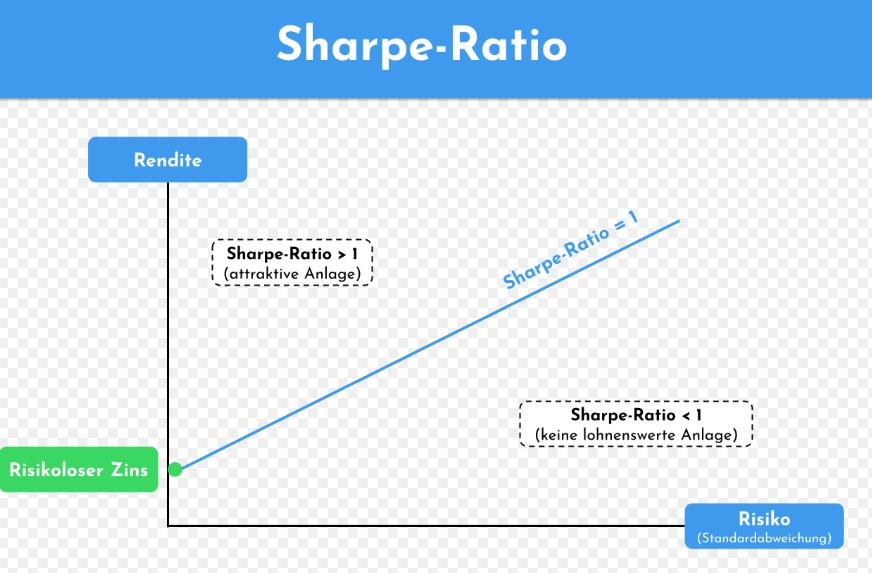
How to Use the Sharpe Ratio in Your Actual Investment Process
So how does this translate to action? Let's get practical.
Step 1: Benchmark Your Current Portfolio. Calculate or find the Sharpe ratio for your main investment holdings over the past 3-5 years. You can often find this on fund fact sheets or portfolio analysis tools from brokers like Vanguard or Fidelity. What's the number? Is it above 1?
Step 2: Use It as a Filter, Not a Decider. When researching new funds or ETFs, screen for those with higher Sharpe ratios than their category peers. If Fund X and Fund Y have similar objectives and fees, but Fund X has a consistently higher Sharpe ratio over multiple time periods, it's a strong point in its favor.
Step 3: Apply it to Portfolio Construction. This is where it gets powerful. Let's say you're deciding how to allocate between a volatile stock ETF (Sharpe: 0.9) and a stable bond ETF (Sharpe: 1.2). The math of modern portfolio theory shows that blending these two, despite the bond's lower raw return, can actually create a combined portfolio with a higher Sharpe ratio than either alone. You reduce overall volatility more than you reduce return, boosting efficiency. This is the magic of diversification, quantified by Sharpe.
Step 4: Track Your Personal Portfolio's Ratio Over Time. Is it improving as you rebalance and add new investments? A rising personal Sharpe ratio means you're getting smarter about managing risk.
In my experience, this is where most DIY investors trip up. They chase returns and ignore this step. They end up with a collection of "winner" funds that, when combined, create a rollercoaster with a mediocre overall risk-adjusted score.
Sharpe Ratio FAQ: Your Burning Questions Answered
 What's a better alternative if I only care about downside risk?
Reader Comments