Let's be honest. Economics can feel like a mess of confusing charts and jargon. You hear about GDP, inflation, and recessions, but how do they all connect? I've been teaching this stuff for over a decade, and the single biggest mistake beginners make is trying to understand each piece in isolation. They study "unemployment" as one topic and "consumer spending" as another, missing the bigger picture entirely.
The circular flow model is that bigger picture. It's not just a textbook diagram; it's a practical mental map of how money, resources, and goods actually move between all of us. Forget the abstract theory for a moment. Think about your last paycheck. You traded your time and skills (a resource) for money. You then spent that money at a grocery store, which paid its employees and suppliers. That money kept moving. The circular flow model simply makes this visible on a national scale.
Here’s the core insight most summaries miss: the model's real power isn't in showing a perfect, balanced loop. It's in showing what happens when the loop breaks or overheats. That's where you understand recessions, inflation, and policy decisions.
Quick Navigation
What is the Circular Flow Model? (Beyond the Basics)
At its simplest, the circular flow model depicts two flows: the physical flow of resources and goods, and the monetary flow of income and spending. Households provide labor, land, and capital to firms. Firms use these to produce goods and services, which they sell back to households. Money flows in the opposite direction, paying for the resources and the final products.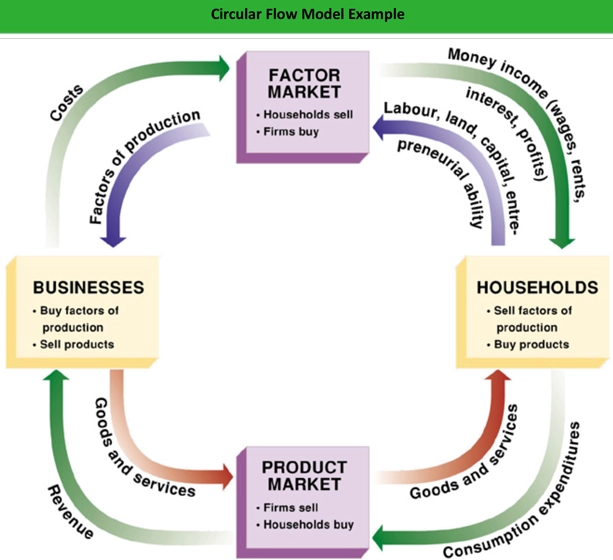
This creates a closed, circular system. It's a helpful starting point, but it's also wildly unrealistic. The classic two-sector model you see in Intro to Econ 101 is like learning the rules of chess by only looking at the pawns. It's necessary, but it won't help you win a game.
The model becomes genuinely useful when we add complexity. We introduce the government sector, which taxes money out of the flow (a leakage) and spends it back in on infrastructure, salaries, and services (an injection). We add the foreign sector (the rest of the world), where money leaves to buy imports and enters when foreigners buy our exports.
The Four Key Players and What They Really Do
Let's move beyond abstract labels. Who are these "households" and "firms," and what are their real-world motivations? Understanding their specific roles is how you start applying the model.
| Participant | Primary Role in the Flow | Real-World Motivation | What They Contribute | What They Receive |
|---|---|---|---|---|
| Households (You & Me) | Owners of resources (labor, capital) and final consumers. | Maximize utility (well-being, security, pleasure). | Labor, land, capital, entrepreneurship. | Wages, rent, interest, profit (as income), then goods & services. |
| Businesses (Firms) | Organizers of production and sellers of goods/services. | Maximize profit and ensure survival/growth. | Goods and services for sale. | Revenue from sales, which is used to pay for resources. |
| Government | Regulator, tax collector, and public spender. | Provide public goods, ensure stability, redistribute income. | Public services (roads, defense, law), transfers (Social Security). | Tax revenue (income, sales, corporate taxes). |
| Foreign Sector | Source of imports and destination for exports. | Access goods/services not available domestically, sell surplus abroad. | Imported goods and services, foreign investment. | Payment for exports, foreign investment inflows. |
Notice the interdependence. A business can't pay wages unless households buy its products. Households can't buy products unless they earn wages. This symbiotic relationship is the engine of the domestic economy.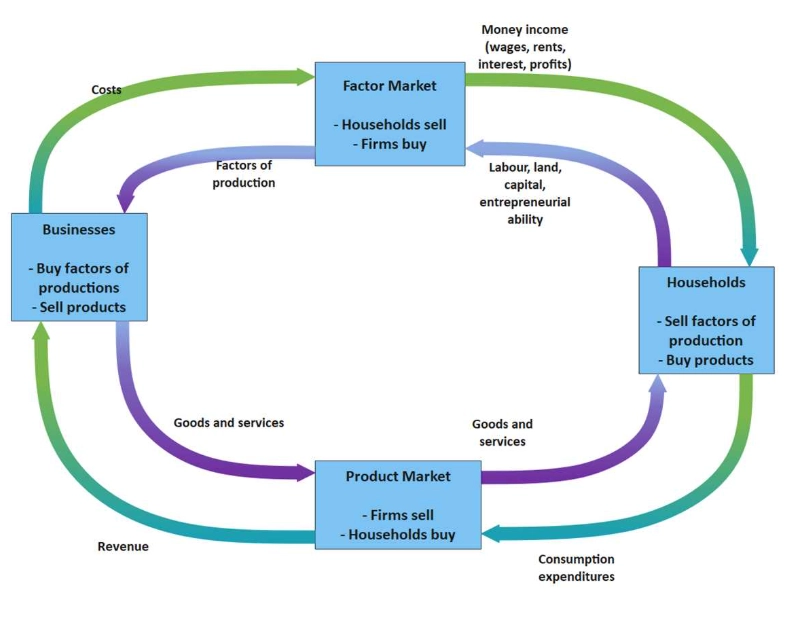
The Critical Twist: Leakages and Injections
This is where the model goes from descriptive to analytical. If everyone just spent every dollar they earned immediately, the flow would be simple. But we don't.
Leakages (or Withdrawals) are money flowing out of the circular flow of domestic income. They represent income not used to buy domestically produced goods and services. The three main types are:
Savings (S): Money deposited in banks or under mattresses instead of being spent. This is often misunderstood as purely positive. While savings fund investment in the long run, an abrupt, widespread increase in savings (like during a panic) immediately reduces the flow of spending to businesses.
Taxes (T): Money paid to the government that is not immediately recirculated (think of it sitting in a treasury account before being spent).
Imports (M): Money spent on goods and services produced abroad. That money leaves the domestic circular flow and enters another country's flow.
Injections are money flowing into the circular flow from outside. They represent new spending that boosts the domestic flow. They directly counter the leakages:
Investment (I): Business spending on capital goods (machinery, factories). This is funded by those savings from the financial sector.
Government Spending (G): All government expenditures on goods, services, and salaries.
Exports (X): Money flowing in from foreign buyers purchasing our domestic output.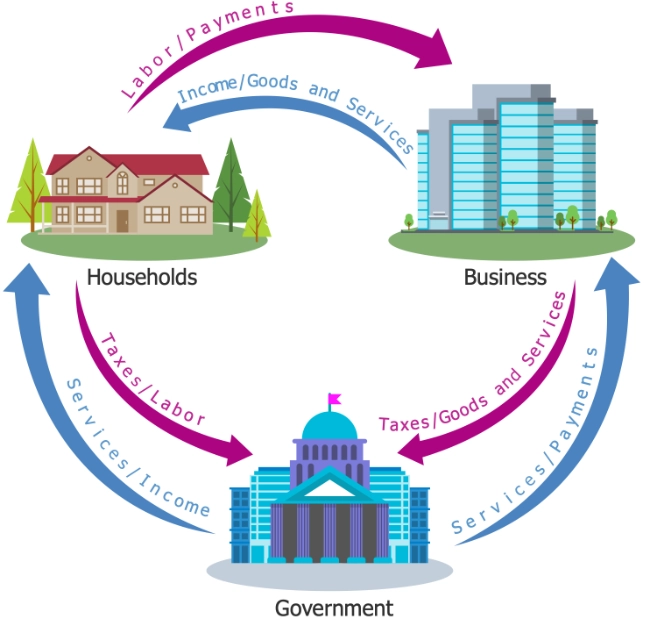
Why This Balance Matters for Growth and Recession
The economy's health, in this model, hinges on the balance between total leakages (S+T+M) and total injections (I+G+X).
If Injections > Leakages: More money is entering the circular flow than leaving it. Total national income (the flow itself) expands. Businesses see more demand, hire more workers, and produce more. This is economic growth. However, if this runs too hot for too long, it can lead to inflation—too much money chasing too few goods.
If Leakages > Injections: More money is draining out than being added. The flow contracts. Business revenues fall, leading to layoffs and reduced production. This is a recessionary gap. Household incomes fall, leading to less spending, creating a vicious cycle. This is precisely what policymakers at the Federal Reserve and in government try to prevent or mitigate.
If Leakages = Injections: The economy is in a stable, but not necessarily ideal, equilibrium. There's no inherent pressure for growth or contraction.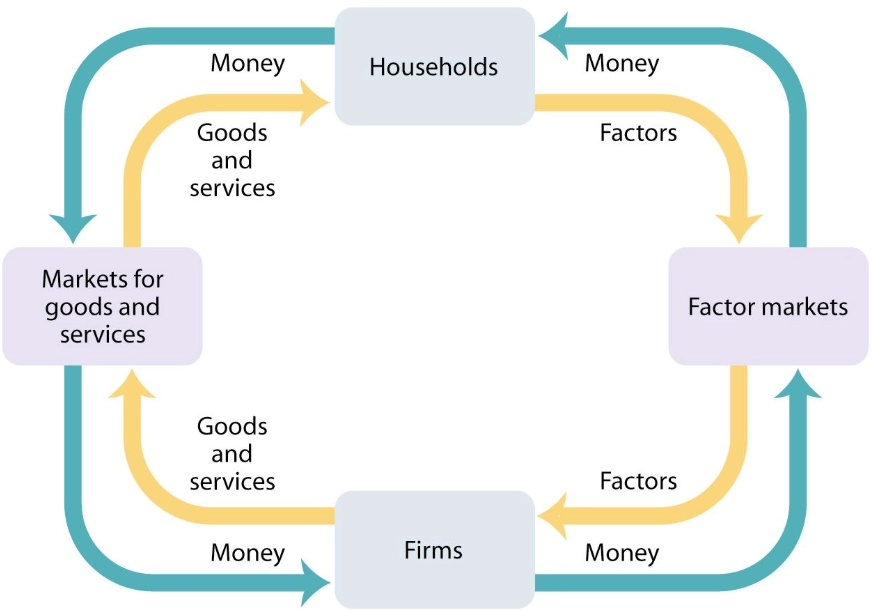
How Can the Circular Flow Model Help You Make Better Decisions?
Okay, so it's a neat theoretical framework. What can you actually do with it? Plenty.
Interpreting Economic News: Next time you read "consumer confidence is down," you can visualize it. Lower confidence typically means households plan to save more (S↑) and spend less. That's an increased leakage. Unless injections rise to match it (e.g., a government stimulus package, G↑), you can anticipate slower economic growth ahead.
Understanding Policy Debates: A call for a tax cut is an attempt to reduce a leakage (T↓) to boost the flow. A call for increased infrastructure spending is an attempt to increase an injection (G↑). The debate often centers on the size of the multiplier effect—how much one dollar of injection actually increases the total flow.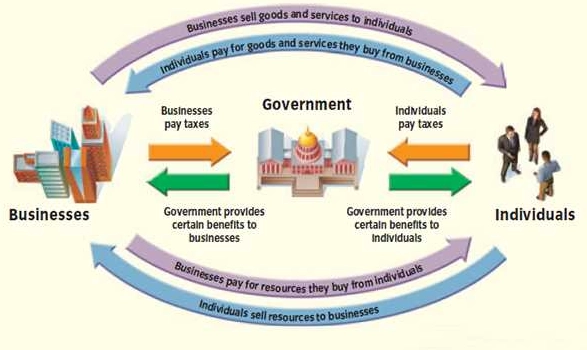
Business Planning: If you run a business selling consumer goods, your revenue is directly tied to the flow of income to households. A macroeconomic environment where leakages are rising (high savings rates, weak export demand) is a warning sign to be cautious about expansion plans.
Personal Finance Context: Your decision to save is a leakage. That's not bad—it's essential for your future and provides capital for investment. But it highlights a systemic truth: for the economy as a whole to thrive, your savings in the bank need to be borrowed and spent by someone else (a business investing or a new homebuyer). If everyone saves aggressively at once, the system seizes up. Data from the Bureau of Economic Analysis on personal savings rates becomes much more meaningful in this light.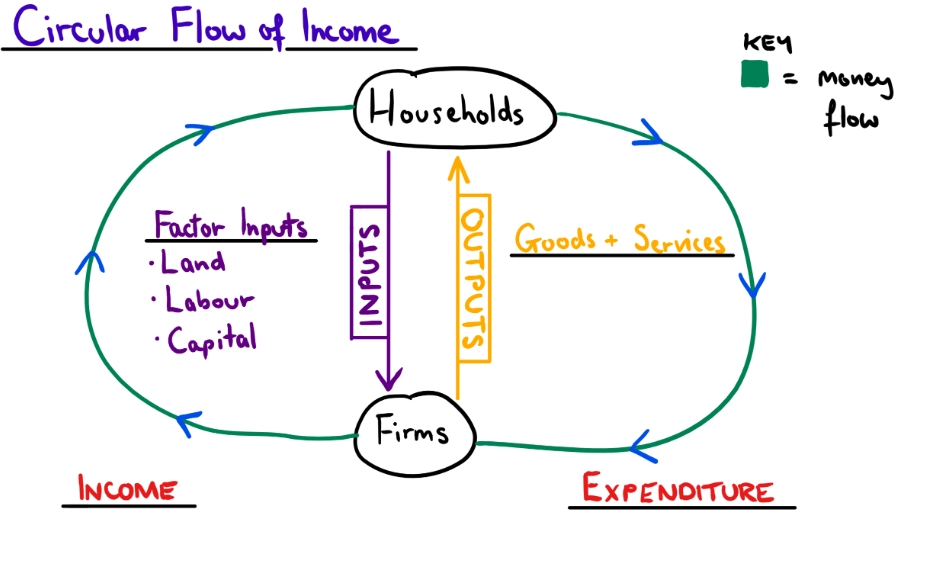
Your Circular Flow Model Questions, Answered
Can the circular flow model predict recessions?
It's not a predictive crystal ball, but it's an excellent diagnostic framework. You can't use it to say "a recession will start in Q3." However, you can use it to identify severe imbalances. If you observe a period where key leakages are persistently rising (e.g., soaring imports coupled with plummeting business investment) while injections are weak, the model clearly shows the flow is contracting. That's the *condition* for a recession. It helps you understand the "why" behind the headlines.
Where do banks and the financial system fit in?
They are the critical plumbing connecting savings (a leakage) to investment (an injection). In the basic model, the financial sector sits between households and firms. It channels idle savings from households into loans for businesses that want to invest in new equipment or buildings. When this plumbing clogs—a credit crunch—savings get trapped as a leakage and can't transform into a productive injection. This breakdown is a central feature of financial crises.
The model seems too simplified. Is it still relevant?
Absolutely, precisely because it's simplified. All useful models are simplifications. A subway map doesn't show every street and building; it shows the connections between stations. The circular flow model is the subway map of the macroeconomy. Its relevance lies in forcing you to see the connections between your paycheck, a company's investment, a government deficit, and a trade imbalance. The mistake is treating the simple model as the complete truth, rather than using it as the foundational map upon which you layer real-world complexity.
How does inflation fit into the circular flow?
Think of inflation as the flow moving too fast for the physical capacity of the economy. If injections massively outpace leakages for a sustained period (say, from huge government spending during a war or supply chain crisis), you have a surge of money income chasing a quantity of goods and services that can't increase quickly. More dollars are flowing, but the output of real goods (the other side of the flow) is constrained. This imbalance—too much monetary demand relative to real supply—manifests as rising prices. The model helps you see that inflation isn't just "prices going up"; it's a symptom of a specific type of imbalance in the circular flow.
Reader Comments